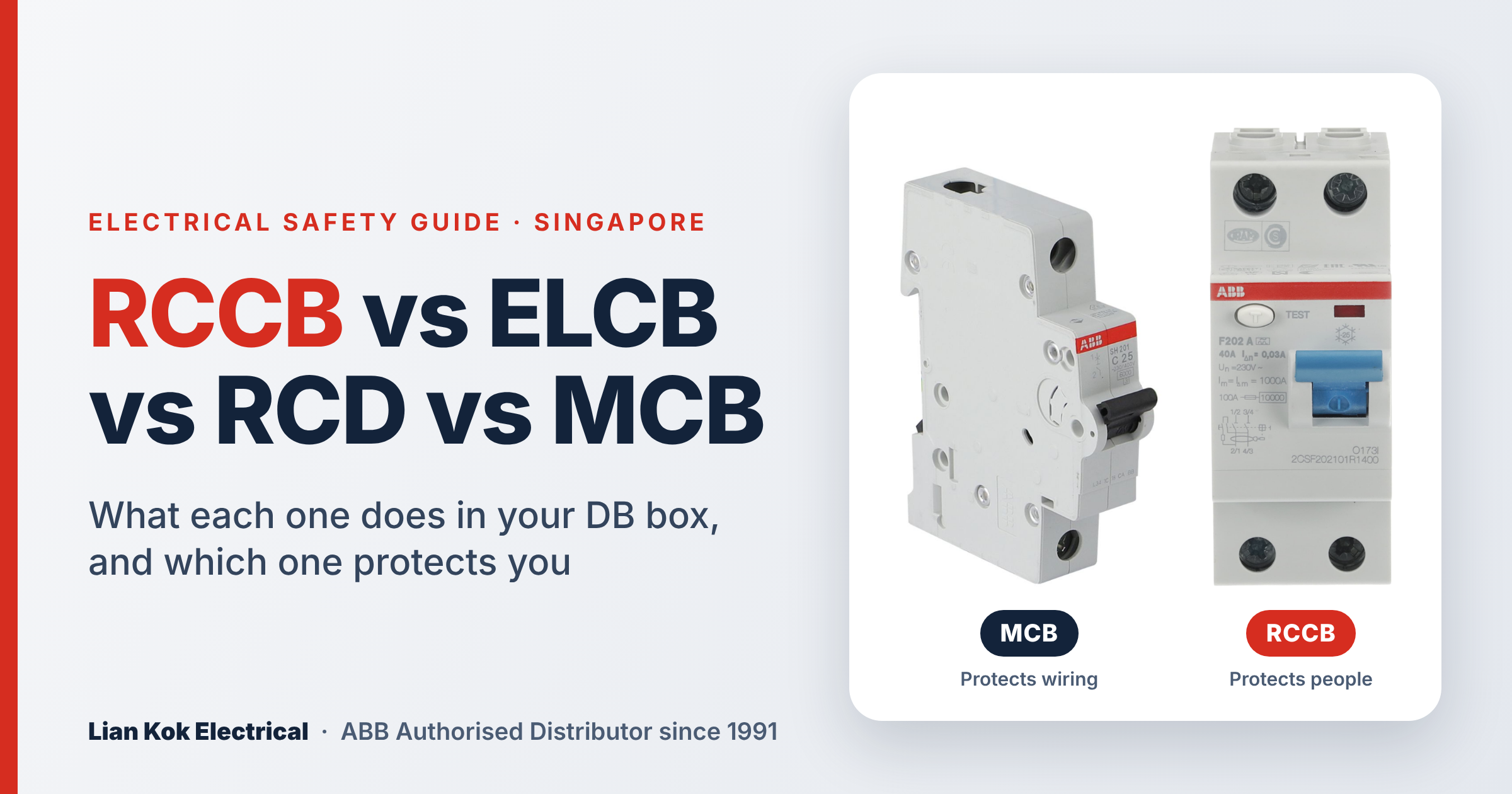
Quick answer: what is the difference between RCCB, ELCB, RCD and MCB?
An RCCB protects people from electric shock by cutting power when current leaks to earth. An MCB protects wiring from overload and short circuits. They do different jobs, so a home needs both. ELCB is the older name for earth-leakage protection, and RCD is the general term that includes the RCCB.
In Singapore this is not optional. The Energy Market Authority (EMA) requires every home to have an RCCB with a rated residual operating current of no more than 30 mA. The two-year grace period ended on 1 July 2025, and homeowners without one can be fined up to $5,000. A Licensed Electrical Worker (LEW) must install it.
This guide explains each device in plain terms, compares them side by side, and shows what each one does in a typical Singapore DB box.
What does each device do?
What is an MCB?
An MCB (miniature circuit breaker) switches off a circuit when it carries too much current, from either an overload or a short circuit. It protects cables and equipment from overheating. It does not sense earth leakage, so it cannot protect a person from electric shock. Our ABB MCB guide covers ratings and selection.
What is an RCCB?
An RCCB (residual current circuit breaker) compares the current flowing out on the live wire with the current returning on the neutral. If the two differ, current is leaking along another path, possibly through a person, and the RCCB trips. For homes, EMA specifies a rated residual operating current of no more than 30 mA. An RCCB does not protect against overload or short circuit, so it works alongside MCBs, not instead of them.
What is an ELCB?
ELCB stands for earth leakage circuit breaker. There are two kinds. Older voltage-operated ELCBs sense voltage on the earth wire, so they depend on a good earth connection and can miss small leakage. Current-operated ELCBs work like an RCCB. Voltage-operated types have largely been replaced by RCCBs. EMA’s page states that an ELCB also meets the home requirement, so check the rating marked on yours.
What is an RCD?
RCD stands for residual current device. It is the general term for any device that trips on leakage current. RCCBs, RCBOs and socket outlets with a built-in RCD are all RCDs. ABB’s SRCD is a switched socket outlet with an integrated RCD; see our ABB CRS RCD socket outlet guide.
What is an RCBO?
An RCBO combines leakage protection and overload protection in one unit. It lets you protect a single circuit on its own, so a fault on that circuit trips only that RCBO.
RCCB vs ELCB vs RCD vs MCB: comparison table
| Device | Protects against | Typical trip level | Protects people from shock | Protects against overload and short circuit | Where you find it |
|---|---|---|---|---|---|
| MCB | Overload, short circuit | Rated in amps (for example 16 A, 32 A) | No | Yes | One per circuit in the DB box |
| RCCB | Earth leakage | 30 mA or less for homes (EMA) | Yes | No | DB box, usually ahead of the MCBs |
| ELCB (voltage-operated) | Voltage on the earth wire | Voltage threshold | Limited; depends on a good earth | No | Older installations |
| ELCB (current-operated) | Earth leakage | Check the rating marked on it | Yes | No | Older DB boxes |
| RCBO | Earth leakage, overload, short circuit | 30 mA typical for homes | Yes | Yes | Individual circuits |
| RCD socket or adaptor | Earth leakage at that point | See the product datasheet | Yes, at that outlet | No | Wall socket or plug-in |
RCD is an umbrella term, so it is not a separate row: the RCCB, RCBO and RCD socket above are all RCDs. Layouts vary, so ask your LEW what is fitted in your own DB box.
How do they work together in a Singapore DB box?
In a typical home, power enters the DB box through a main switch and an RCCB, then splits into MCBs, one per circuit such as lights, sockets, air-con and water heater. Each MCB guards its own circuit’s wiring. The RCCB watches for leakage across the circuits. Layouts vary, especially in older flats or where circuits were added later.
How to check yours: open the DB cover and look for a switch with a Test button. Press it once a month. If it does not trip, or if it trips often without an obvious cause, contact an LEW.
What not to do: do not add, replace or rewire devices in the box yourself. Installing an RCCB, or moving or extending a power point, needs a Licensed Electrical Worker. You can check an LEW’s licence on EMA’s ELISE portal.
Want a fuller tour of the board? See our guide on how to read your DB box [link when published].
Which one do I need for my home or business?
- Home built from 1985 onwards: it should already have an RCCB. Confirm it is marked 30 mA or less and test it monthly.
- Home built before 1985: EMA notes that older HDB flats generally did not come with an RCCB. Its 2023 release said the Government would fund or subsidise installation for eligible older flats. Check with HDB for what still applies.
- Renovating: ask your LEW whether individual RCBOs suit your layout, for example for air-con and water heater circuits.
- One extra socket that needs protection: an RCD socket such as the ABB SRCD socket outlet or the T&J 13A adaptor with residual current protection adds protection at that point. It supplements the RCCB in the DB box; it does not replace it.
- Shops, offices and factories: you still need overload and leakage protection, and the right sensitivity depends on the load. Some industrial circuits use 100 mA or 300 mA to limit nuisance tripping. That is a design decision for your LEW or engineer.
Which RCCB and RCD products does Lian Kok supply?
Lian Kok Electrical Pte Ltd has been an ABB Authorised Distributor in Singapore since 1991. For leakage and circuit protection we supply:
- ABB RCCBs (residual current circuit breakers)
- ABB SRCD socket outlets
- ABB MCBs
- T&J 13A adaptor with residual current protection
For single units, buy on our Shopee (https://shopee.sg/lkeonline) or Lazada store (https://lazada.sg/shop/lke-online). For trade quantities or help choosing a rating, contact us or call +65 6298 6822. We are at Block 681 Race Course Road, #01-317, Singapore 210681.
Frequently asked questions
Is an RCCB compulsory in Singapore?
Yes. EMA requires all residential premises to have an RCCB with a rated residual operating current not exceeding 30 mA. The grace period ended on 1 July 2025. Homeowners without one can be fined up to $5,000, and a Licensed Electrical Worker must install it.
What is the difference between RCCB and ELCB?
An RCCB detects current leaking to earth by comparing live and neutral current. ELCB is the older name. Voltage-operated ELCBs sense voltage on the earth wire and depend on a good earth, while current-operated ELCBs work like an RCCB. Voltage-operated types have largely been replaced by RCCBs.
Does an ELCB meet EMA’s requirement?
EMA’s RCCB page states that an ELCB also satisfies the requirement. Check the rating marked on yours, and ask a Licensed Electrical Worker if you are unsure which type you have.
Can an RCCB replace an MCB?
No. An RCCB only detects earth leakage. It does not protect against overload or short circuit, so a home needs both an RCCB and MCBs. An RCBO combines both functions in one unit.
What does SRCD mean?
SRCD refers to a switched socket outlet with an integrated residual current device, as in ABB’s SRCD range. It adds shock protection at that socket and supplements the RCCB in your DB box.
How do I test my RCCB?
Open the DB cover, find the switch marked Test, and press it once a month. The RCCB should trip. Switch it back on afterwards. If it does not trip, call a Licensed Electrical Worker.
Why does my RCCB keep tripping?
It is detecting leakage. Possible causes include a faulty appliance, a damaged cable or damp in the wiring. Unplug appliances and switch the RCCB back on once. If it trips again, or trips often without an obvious cause, engage a Licensed Electrical Worker. Never bypass or tape down the switch.
What does Type AC or Type A mean on an RCCB?
Type AC trips on sinusoidal AC leakage current. Type A also trips on pulsating DC leakage, which some electronic appliances can produce. Your Licensed Electrical Worker will specify the type your installation needs.
Sources
- EMA: RCCB requirement (30 mA, 1 July 2025, monthly test, LEW)
- EMA media release, 12 May 2023 (older homes, fine, HDB funding)
- EMA: five common electrical safety questions, 2025 (testing, when an LEW is needed)
- Schneider Electric: RCCB and ELCB difference (ELCB types, RCBO, sensitivity ratings)

Leave A Comment